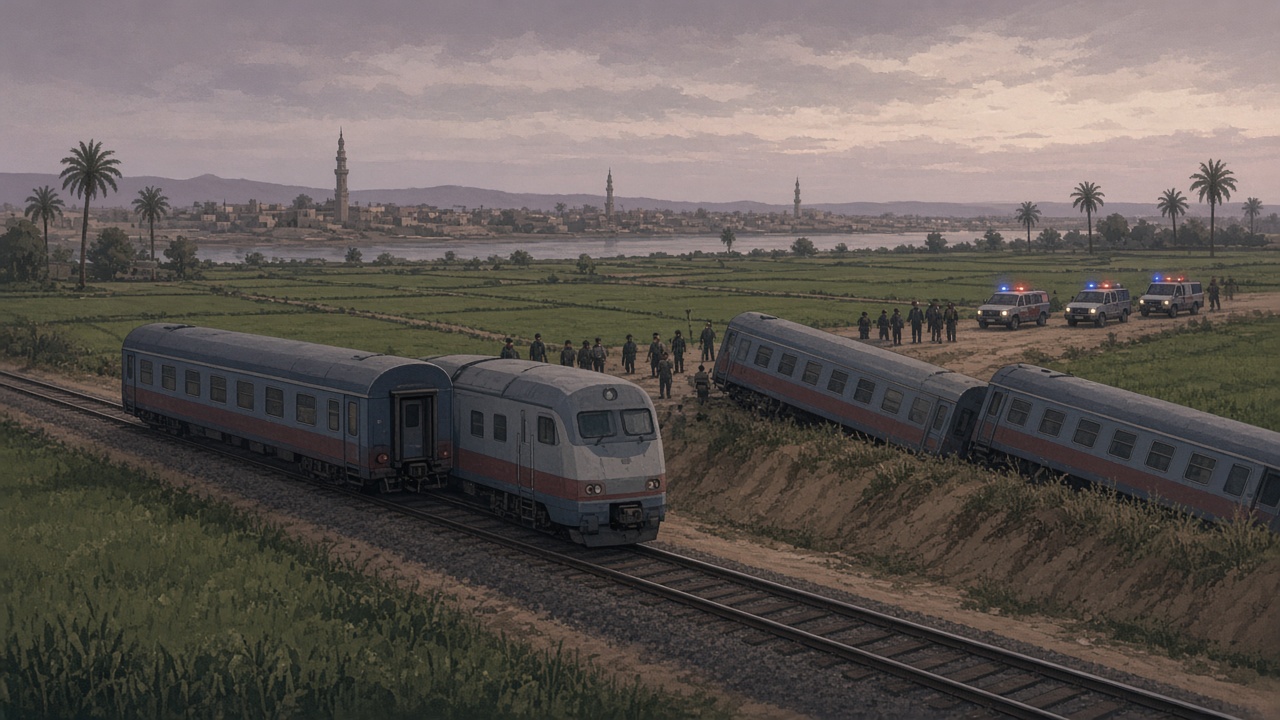
A southbound passenger train slammed into the back of another train that was standing still on the same line south of Cairo on Sunday, killing at least seven people and injuring well over a hundred, Egyptian authorities said. The crash in the al-Ayyat district of Giza province has once again put Egypt’s rail safety record under the spotlight, at a stretch of track that has seen some of the country’s worst train disasters.

Here is what is known so far, what investigators are looking at, and why the location matters.
What happened
According to Egypt’s Ministry of Transport, train No. 134, a “Tahya Misr” service running from Giza to Fayoum, struck the rear of train No. 2010, which was heading from Cairo to the southern city of Aswan. The Public Prosecution Office said after inspecting the scene and speaking to witnesses that the Cairo–Aswan train had stopped on the tracks and that both trains were travelling in the same direction.
The impact derailed several carriages. The transport ministry said four carriages came off the rails and overturned, and the BBC reported that some fell down an embankment. The collision happened between Kafr Ammar and Al-Raqqa stations, about 52 kilometres (32 miles) south of Cairo, according to the BBC and the Associated Press.
Casualty figures are still being updated
The numbers have shifted through the day as officials released new statements, so all figures here are as reported by authorities and may change. The Health Ministry initially reported four deaths and 88 injuries before raising the toll to seven dead. The AP, citing the ministry, reported at least 125 people injured, with more than 70 already discharged after treatment. The prosecution’s initial estimate put the injured at 114. The driver of the Giza–Fayoum train is among those who died, the ministry confirmed.
More than 70 ambulances were sent to the scene, and the wounded were taken to hospitals in al-Ayyat, Atfih and al-Wasta in neighbouring Beni Suef province. Health Minister Khaled Abdel Ghaffar said patients were being treated mainly for broken bones and head injuries, according to the BBC. The Egyptian Red Crescent said it was providing aid and psychological support at the site. The prosecutor’s office warned that the death toll could still rise.
Investigation launched
President Abdel Fattah al-Sisi said he had ordered authorities to “investigate the circumstances of the accident, and hold accountable anyone found to have been negligent,” the BBC reported. Prosecutors formed a specialist technical committee to examine the tracks and damaged carriages and to determine whether there were shortcomings in operating procedures or safety requirements.
No official cause has been announced. An Egyptian National Railways board official told the outlet Al Manassa that two preliminary scenarios are being examined: a possible fault in the signalling system that may have told the driver to proceed, or the possibility that the driver did not follow signals and instructions. The official stressed that neither can be confirmed until technical inspections and formal investigations are complete.
Rail traffic halted and reaction
Train services between Giza and Upper Egypt were suspended while cranes were brought in to remove the wreckage, and the railway authority has not said how long that will take. The BBC reported calls in Egypt on Sunday for the transport minister to resign. Saudi Arabia’s foreign ministry expressed solidarity with Egypt, and Turkey’s ambassador in Cairo offered condolences to the victims and their families.
Why it matters
Al-Ayyat carries a heavy history. It is close to the site of Egypt’s deadliest rail disaster in February 2002, when a fire swept through a Cairo-to-Luxor passenger train and more than 370 people were officially reported killed. Two further crashes in the area in 2009 killed dozens more, according to the BBC. The findings of this investigation, especially whether the cause was a technical failure or human error, will be closely watched by millions of passengers who rely on the Upper Egypt line every day.
Sources
- BBC News: Seven dead and more than 100 injured after trains collide in Egypt
- BBC News live: At least seven killed and more than 100 injured in Egypt train collision
- Associated Press: Collision between 2 trains in Egypt kills 7 and injures at least 125
- Al Manassa: Train collision in Egypt’s Al-Ayyat
Leave a Reply